Broadband sound played into the room shortened how long healthy sleepers took to fall asleep, in an attended overnight laboratory study.
Frontiers in Neurology, 2017 drowsie
drowsie
drowsie
Science and research
What the speaker reads from under your pillow, how those readings are benchmarked against the best on the market, and the published research it is built on.
 MovementBreathing rateHeart rateWhen you settled
The data underneath
5,500+
hours of real sleep measured
2 million+
movement measurements every night
1 billion+
measurements analysed so far
3 axes
of movement, read through the night
Built on more than 5,500 hours of real sleep. Drowsie reads your movement on three axes, which is more than 2 million measurements in an eight-hour night and over a billion analysed so far. A proprietary algorithm, developed in-house, turns that stream into your night.
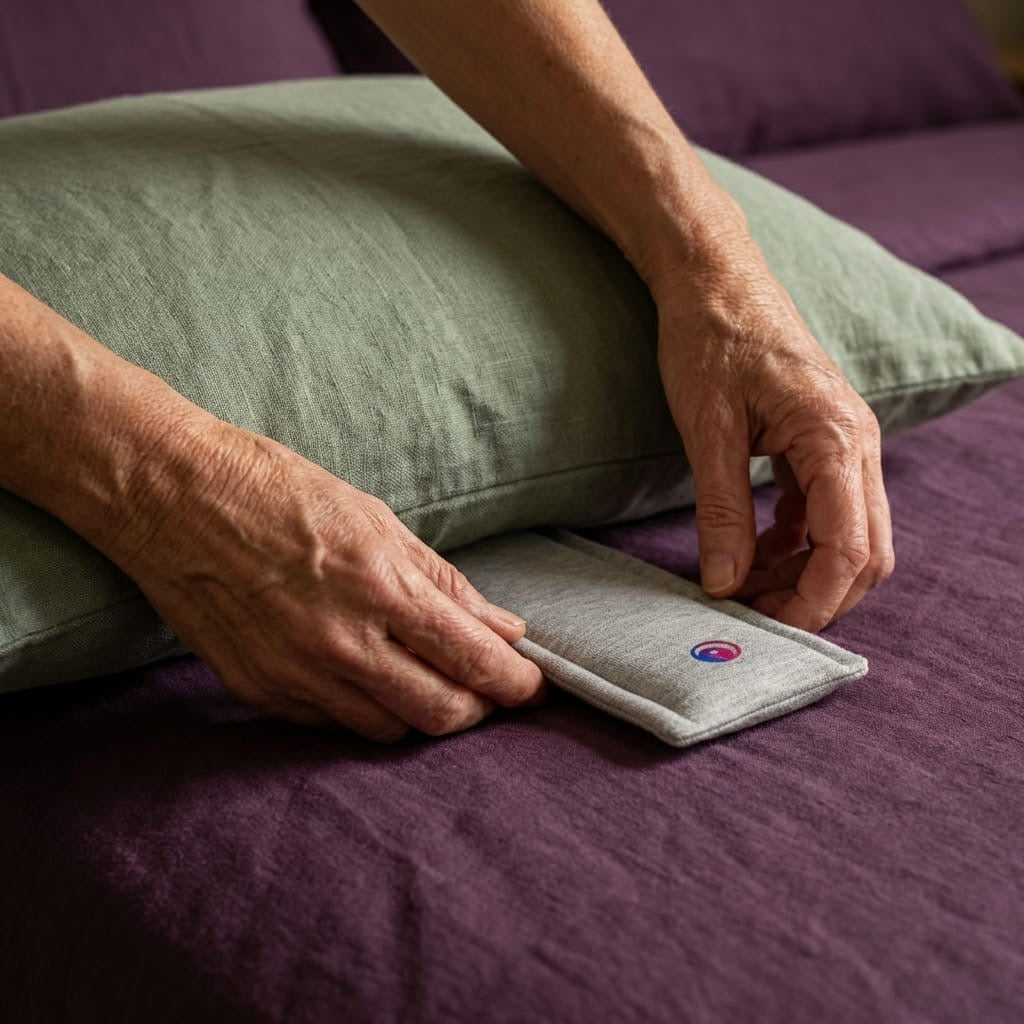
A thin speaker lies flat under your pillow — not inside the pillowcase. The sound travels up through the pillow to your ear, so the other side of the bed hears almost nothing. There is nothing in your ear, nothing on your wrist, and nothing to charge every day.
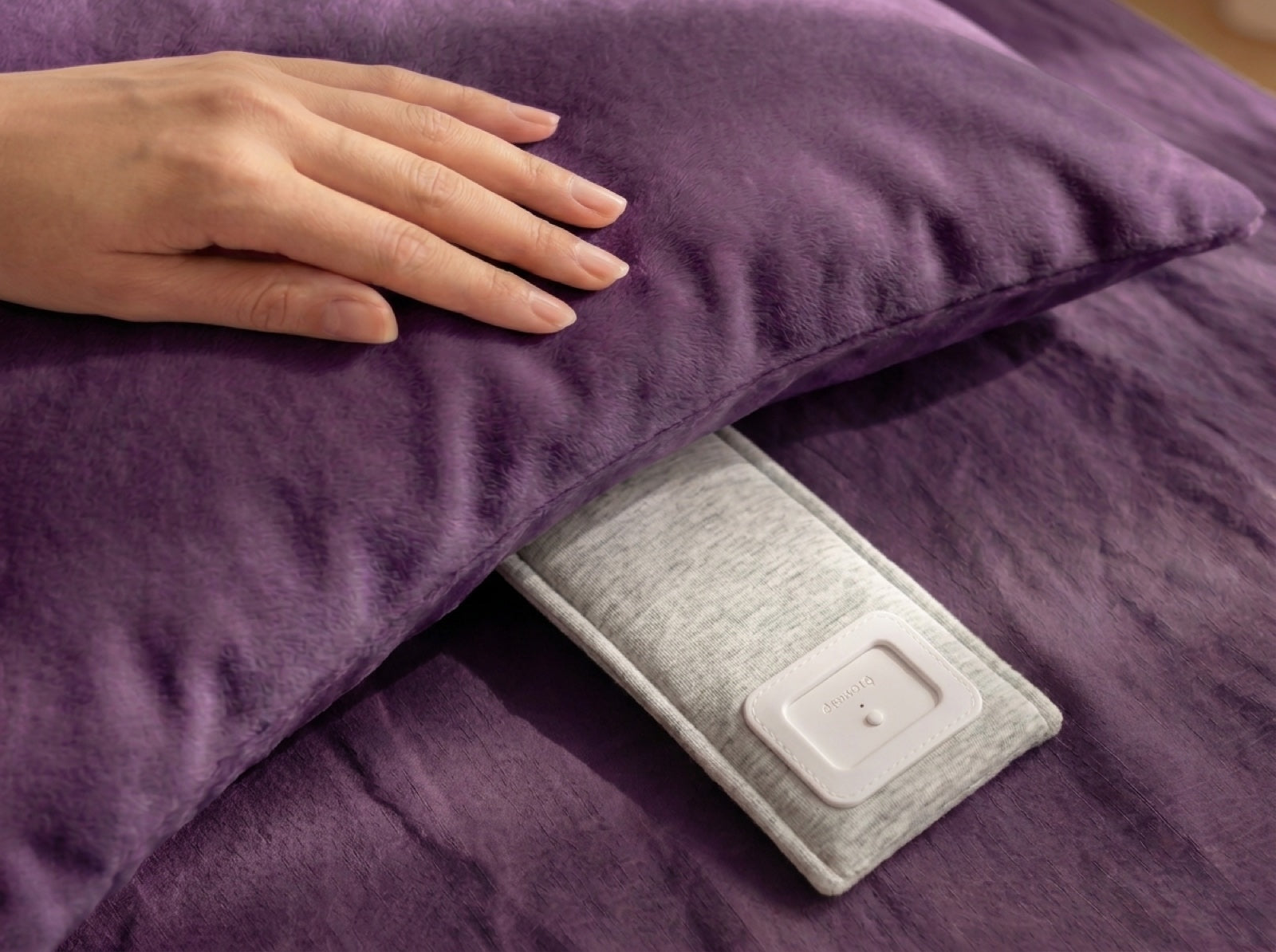
A motion sensor inside the speaker reads the small movements your body makes through the pillow. That is the whole sensing story. Drowsie senses movement only. It does not record sound. Nothing about your night is worked out from anything you say or hear.
Breathing moves you, and so does a heartbeat, even when you are lying still. Drowsie’s proprietary algorithm picks both rhythms out of that movement, and we benchmark them minute by minute against a market-leading wearable: breathing agrees within 2 breaths a minute on nearly 9 minutes in 10, and when Drowsie reports a heart rate it is within 5 beats a minute 93% of the time. Signal-quality gating is why: Drowsie only shows a heart rate when the signal is clear.
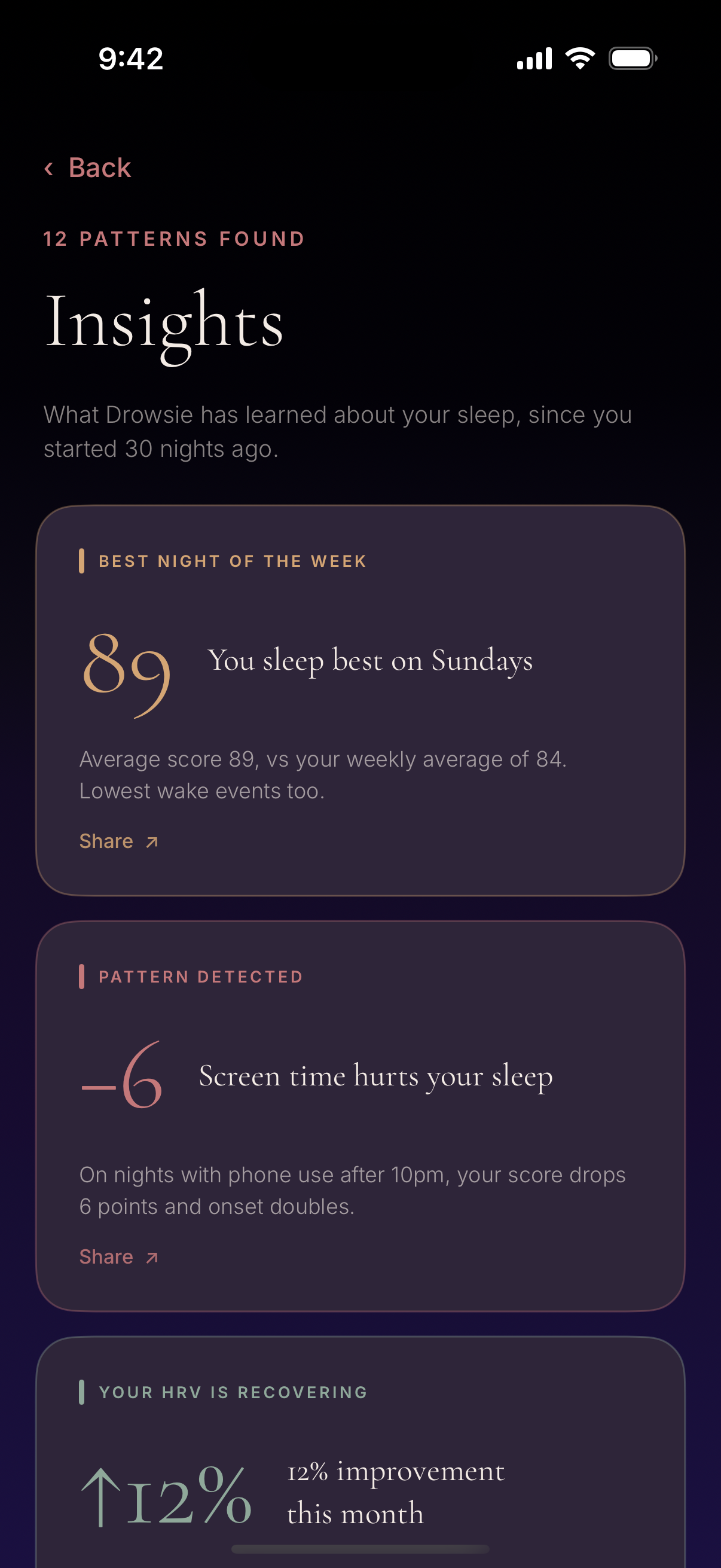
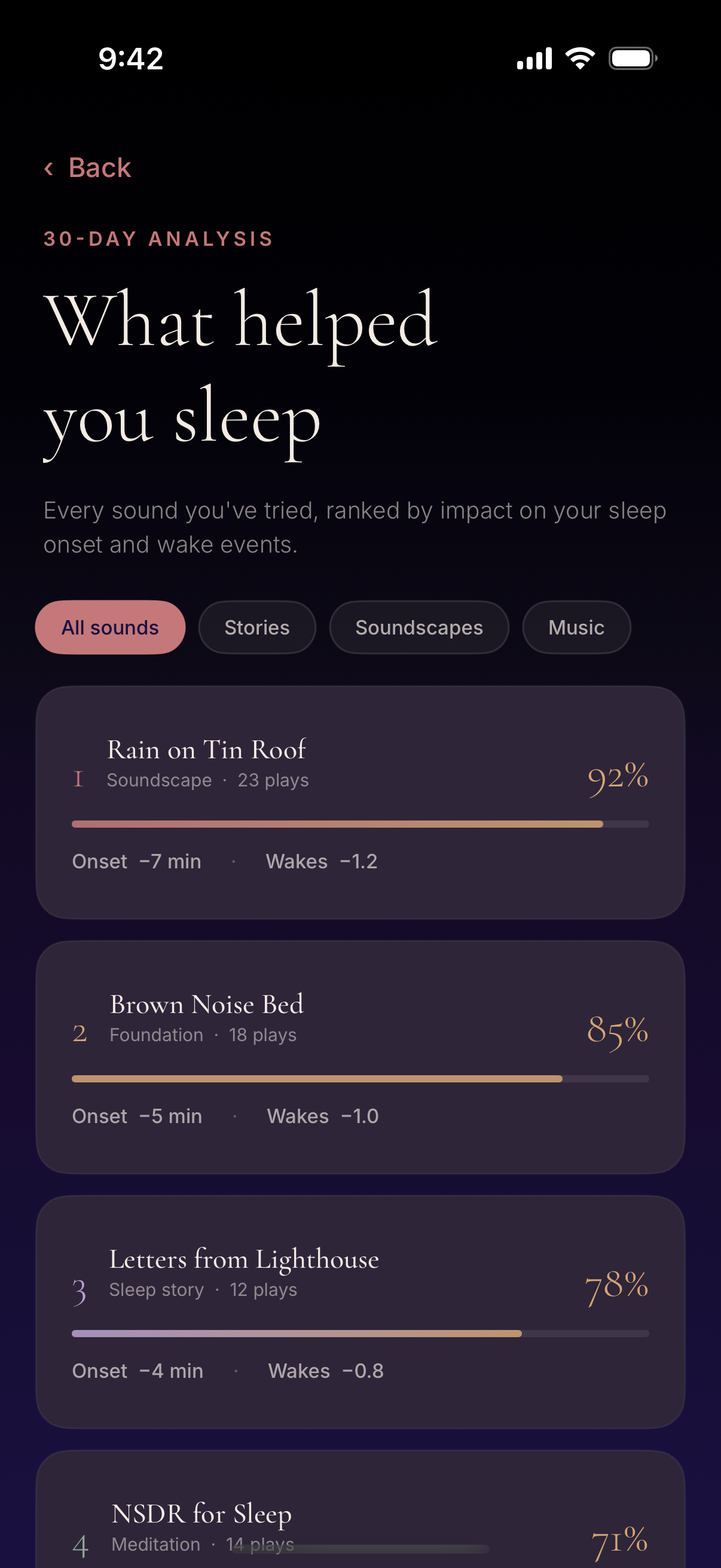
A proprietary algorithm compares your nights with a sound against your nights without one, and shows you the difference night by night. It does not tell you the difference is an improvement. It counts, and it shows you the count.
“I did not want another tracker that hands you a chart in the morning. I wanted the thing under the pillow to use what it reads while you are still asleep, and actually do something about your sleep, automatically.”
MNFounder, Drowsie
From one place: the movement of your body through the pillow. Nothing on your wrist, nothing on your finger, and no recording of your room.
What it reads
How much you move, minute by minute — the signal every movement-based sleep tracker is built on, read through the pillow instead of off your wrist.
Whether anyone is on the pillow at all. That is how Drowsie knows you got up at 2am, and how long you were gone.
Your breathing rhythm, picked out of the same movement, reported through the night and benchmarked against a market-leading wearable.
A heartbeat moves you too, faintly, and the pillow feels it. Drowsie only shows a heart rate when the signal is clear — it would rather show you nothing than a guess.
An estimate built from movement and breathing.
What it plays
Rain, fans, stories, meditations — or whatever you already play from the apps on your phone.
When what you picked runs out, Drowsie keeps the night going on its own.
The sound steps back once you settle, and plays again if you stir.
What you tell it
One tap in the morning. Your own read on the night goes in beside what the speaker measured.
Thumbs on what you liked. A sound you disliked stops coming back, whatever the numbers say about it.
Drowsie senses movement only. It does not record sound, so there is no recording of your room to keep, to leak, or to hand to anybody. Your nights are yours: you can see every one of them in the app, and you can ask us to delete the lot.
Every figure here is produced the same way: Drowsie’s night and a market-leading wearable’s night, lined up minute by minute, on the same nights, on the same person.
93%
of heart-rate readings within 5 bpm of the reference wearable
9 in 10
minutes within 2 breaths a minute of the reference wearable
25 min
typical agreement on time asleep with the reference wearable
All
out-of-bed events detected in our benchmark nights
Benchmark method: every reading compared minute by minute against a market-leading wearable worn on the same nights, by the same sleeper.
Every figure on this page is produced the same way, under the same rules. This is the protocol behind them.
Every figure comes from complete overnight recordings in a normal bedroom — lights out to waking, with get-ups, bad nights and a partner on the other side of the bed. Nothing here is a staged demo or a clean ten-minute sample.
Drowsie’s night and the reference night are lined up minute against minute, not summed and compared at the end. Totals can agree by accident; minutes cannot.
Drowsie only shows a heart rate when the signal is clear. Some minutes come back blank instead of coming back wrong — that is deliberate, and it is the reason the figures we publish hold.
Both are read from real movement on a real night, by the speaker under a real pillow — not inferred from a model, not simulated, and not borrowed from somebody else’s study. Sleep stages are the one exception, and they carry the word estimate everywhere they appear.
Drowsie’s own results are further up this page. These are other people’s — published, and checked by their own field. They are what the approach is built on, not claims about our product.
Broadband sound played into the room shortened how long healthy sleepers took to fall asleep, in an attended overnight laboratory study.
Frontiers in Neurology, 2017A 1992 study of wrist actigraphy reported that the movement-scoring algorithm most sleep researchers still use told sleep from wake about 88% of the time against a sleep laboratory.
SLEEP, 1992A 2020 engineering study using a body-worn motion sensor reported breathing rate to within about two breaths a minute across most of the night, with the error smallest for side sleepers.
IEEE Engineering in Medicine and Biology, 2020Against a sleep laboratory, wrist movement was very good at spotting sleep and much weaker at spotting the minutes a person lay awake — the limit every movement-based tracker shares, Drowsie included.
SLEEP, 2013A systematic review of noise as a sleep aid found continuous noise tended to shorten sleep onset and reduce fragmentation, with wide variation between studies and low overall certainty.
Sleep Medicine Reviews, 2021An accelerometer mounted under the mattress recovered breathing signals through the bed, with nothing worn by the sleeper.
Sensors, 2023Pooled across randomised trials, white noise was associated with better sleep — on evidence the authors themselves rated low in quality.
Sleep Medicine, 2025A later refinement of the wrist movement scoring algorithm, developed and tested on sleep laboratory patients.
Journal of Sleep Research, 2010Across randomised trials, listening to music before bed shortened the time people took to fall asleep and improved sleep efficiency.
European Psychiatry, 2024The first full overnight validation of breathing rate taken from a chest-worn motion sensor, measured against a clinical reference.
Biomedical Signal Processing and Control, 2022A systematic review gathering what is known about playing sound to people while they are asleep, across the range of methods that have been tried.
Journal of Clinical Sleep Medicine, 2022A randomised controlled trial testing sound timed to the listener’s own brain rhythm against a sham, in people with sleep-onset insomnia.
Scientific Reports, 2024No. Drowsie senses movement only. It does not record sound. Everything it knows about your night comes from the small movements your body makes through the pillow.
No. Nothing on your wrist, nothing on your finger, nothing in your ear. The speaker lies flat under the pillow you already sleep on, and it reads the night from there.
Under the pillow — not inside the pillowcase. It is thin enough that you do not feel it through the pillow, and that is also the position the sound is designed for: up through the pillow, to your ear.
Benchmarked minute by minute against a market-leading wearable worn on the same nights: time asleep agreed to within about 25 minutes a night, breathing rate agrees within 2 breaths a minute on nearly 9 minutes in 10, and when Drowsie reports a heart rate it is within 5 beats a minute 93% of the time. Every out-of-bed event in those nights was detected. Sleep stages are an estimate and we say so every time. See the full benchmark.
No. Drowsie counts the difference between your nights with a sound and your nights without one, and shows you that count. Whether the difference is an improvement is a claim we have not earned, so we do not make it.
Drowsie is listed on the Australian Register of Therapeutic Goods as a sound device that tracks sleep from under the pillow. It does not diagnose or treat anything, and it is not a substitute for seeing a doctor about your sleep.
★★★★★ 4.4 · 10,000+ happy sleepers · 8 in 10 members use Drowsie every week
Under the pillow, all night, learning as it goes. A$179 for the year, which is A$3.44 a week.
Get yours todaySee how it works
60-night guarantee, on at least 30 of those nights.